


Newsletter
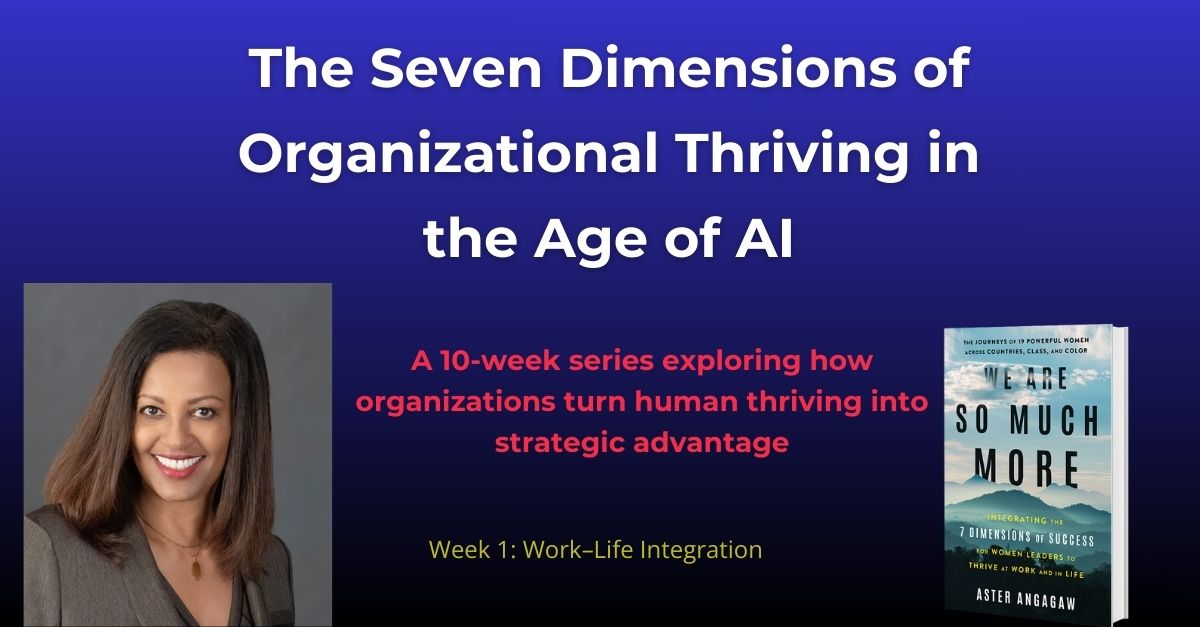
By Aster Angagaw
September 15, 2025
AI is moving fast. Every week brings new tools that change how we produce, measure, and manage. With that speed comes a dangerous narrative: if machines can do the work, maybe people don’t matter as much anymore.
That idea is tempting for some leaders. They double down on performance-only cultures — where output is everything and empathy, integration, and humanity are treated as distractions. Employees are expected to adapt endlessly, burn out quietly, and compete with automation instead of working alongside it.
But here’s the truth: the more AI advances, the more people matter.
AI can calculate and predict. What it cannot do is create meaning, build trust, or lead with courage. The human edge isn’t disappearing. It’s becoming more valuable. The real advantage lies in how well companies help people thrive — and build cultures that unleash merit at the highest level.
The Problem With How We See It
Work-life integration has too often been framed as an individual issue.
“Manage your time better.” “Practice self-care.” “Build resilience.”
That’s the advice employees get — even when systems make it nearly impossible.
The result? Burnout. And burnout isn’t a personal weakness. It’s a system failure.
When organizations chase performance at all costs without investing in empathy and integration, they erode the very engagement that drives results. Short-term numbers may look strong, but the culture underneath starts to crack.
And in the AI era, the risk is sharper. If people feel they’re competing with machines, efficiency becomes the only metric. Companies may gain speed but lose loyalty, creativity, and trust.
Here’s another way to think about it: perhaps what we need is not just work-life integration but work–human integration. Because humans themselves are not automatable, employees may be treated as replaceable, but people are creators, innovators, and consumers of meaning — not just doers of tasks.
AI Elevates the Human Factor
What defines great organizations cannot be automated:
- Creativity — connecting dots in new ways.
- Emotional intelligence — building trust, leading with empathy.
- Resilience — adapting to uncertainty.
- Moral judgment — aligning choices with values, not just profits.
These are not “soft” skills. They are hard edges of competitiveness. And they only thrive when organizations treat work–life and work–human integration as strategy, not perks.
💡 In my own career leading multi-billion-dollar P&Ls, I saw it firsthand. Cultures of integration consistently outperformed cultures of grind. Teams that thrived delivered stronger results — quarter after quarter.
Why Integration Is Capital
Work-life integration is not a luxury. It’s a form of capital that compounds:
- Lower turnover → reduced costs.
- Stronger innovation → psychological safety sparks new ideas.
- Higher engagement → belonging translates into customer loyalty.
Organizations that embed integration through leadership and policy don’t dilute performance. They amplify merit.
From Women’s Lens to Universal Value
When I wrote We Are So Much More, I focused on women’s experiences. Women are often expected to carry impossible standards of integration while advancing in their careers.
But the deeper I worked with these ideas, the clearer it became: this framework is universal.
The seven dimensions I outlined — from self-care to purpose — are human needs. Men and women alike flourish when organizations honor them. And when people thrive, contributions don’t shrink. They sharpen.
This is also about the future workforce. Early-career employees — our children — are entering workplaces that feel full of possibility but also riddled with uncertainty. If they see organizations treating people as disposable, they disengage before they even begin. But if they see companies valuing humans as creators and innovators, they find purpose and loyalty. Their future, and ours, depends on it.
The Seven Dimensions of Organizational Thriving
Over the next 10 weeks, I’ll share a new series: ✨ The Seven Dimensions of Organizational Thriving in the Age of AI ✨
Each week, I’ll reframe one dimension from the individual to the organizational level:
- How can organizations institutionalize self-care?
- What does true community mean inside a company?
- How do leaders design growth so people never plateau?
- How can purpose, creativity, and financial well-being become enterprise strategies?
- How does leadership balance empathy with performance?
By the end, you’ll see a new definition of organizational capital — one where people are not costs to minimize but the advantage to maximize.
A Call to Leaders
AI will reshape how work gets done. But the bigger question is: What will it mean to be human at work?
Leaders face a choice:
- Embrace a performance-only culture, where people are replaceable.
- Or build a culture of integration — work-life and work-human — where merit thrives because people do.
💡 My experience leading global businesses taught me this: performance is never just financial. It is cultural. And when culture thrives, the numbers follow.
That choice will determine not just how organizations survive disruption, but how they thrive because of it.
Looking Ahead
Next week, I’ll dive into the first dimension: Self-Care — and why organizations must institutionalize rest and renewal.
Until then, I’d love to hear from you: As AI transforms your business, do you believe empathy and merit can coexist in leadership — and what does that mean for the next generation entering the workforce?
About the Author
Aster Angagaw is an accomplished Fortune 500 executive and author of We Are So Much More. She has led multi-billion-dollar P&Ls, scaled organizations across continents, and built high-performing teams at the intersection of people and performance. Through Astellara, she now advises companies and leaders on how to integrate culture, strategy, and innovation to drive sustainable growth in the age of AI.
Author’s Note: Portions of this article were developed using Microsoft Copilot and ChatGPT. It has been reviewed and edited by me; all final insights and conclusions are mine.
#Leadership #FutureOfWork #AI #OrganizationalCulture #WorkLifeIntegration #WorkHumanIntegration