

Newsletter
By Aster Angagaw
September 15, 2025
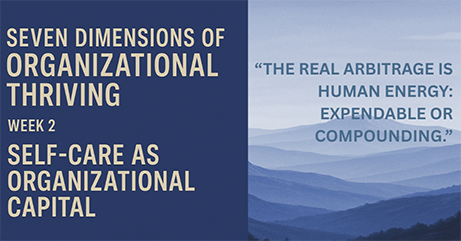 Leveraging AI to Protect Human Energy and Enterprise Value
In the boardroom, self-care rarely shows up on the capital allocation agenda. Yet the cost of neglecting it is real: turnover, lost innovation, and cultural erosion.
The same principles that protect financial assets apply to human assets. If you do not invest in them, they depreciate.
Strategic self-care is organizational capital that flows from three sources: people, performance, and technology. When leaders align these forces, they create conditions where energy, innovation, and AI-enabled systems reinforce one another.
In the AI era, machines can accelerate output but cannot replenish human energy. Protecting that capital is a CEO-level responsibility that cascades from the boardroom to every level of leadership.
The Cost of Neglect: Burnout and Quiet Quitting
When people burn out, companies pay.
- 36% of managers report burnout and are 24% more likely to consider quitting (McKinsey Health Institute)
- Burnout is recognized by the World Health Organization as an occupational phenomenon tied to higher turnover, healthcare costs, and productivity loss
- Quiet quitting, employees doing the minimum, is linked to burnout, poor leadership, and lack of growth opportunities (Gallup)
Personal consequence: exhaustion, disengagement, and stalled growth. Organizational consequence: capital erosion, discretionary effort drains away, weakening innovation, customer loyalty, and cultural resilience.
Takeaway: Burnout is not just a wellness issue. It is asset depreciation.
The ROI of Well-Being
Investment in workforce health delivers measurable returns.
- A healthier workforce could unlock $11.7 trillion in global economic value (WEF & McKinsey)
- Some firms save up to $6 for every $1 spent through lower medical claims and absenteeism (RAND Corporation)
Takeaway: Well-being is not a perk. It is enterprise value protection.
AI as a Strategic Enabler of Self-Care
AI’s highest ROI is not in replacing people. It is in removing the friction that drains them.
- At Mass General Brigham, ambient AI documentation cut clerical load by 21% and boosted well-being by 30% (JAMA Network Open)
- Analytics can surface system-level stress signals such as chronic overtime or uneven workloads before they cascade into costly turnover
- AI enables personalized support at scale, aligning resources with role demands instead of relying on one-size-fits-all programs
Takeaway: When used responsibly, AI does not monitor people. It protects human energy, restores time, and compounds performance.
CEO Actions: Managing Human Capital Like Financial Capital
Leaders at every level can embed self-care as organizational capital by:
- Measuring with rigor — Track engagement, absenteeism, and turnover as closely as financial KPIs
- Designing for prevention — Build operating models and job structures that protect well-being before crisis hits
- Integrating AI strategically — Deploy tech to eliminate low-value work and personalize support
- Modeling the behavior — Take time for renewal, set boundaries, and show that well-being and performance reinforce each other
- Committing long-term — ROI compounds as programs mature and culture shifts
Takeaway: When leaders model the behavior, they normalize it. Self-care cascades faster through example than through policy.
The Boardroom-to-Every-Level Imperative
From the board to the front line, the mandate is the same:
- Protect the human energy that drives performance
- Use AI not just to accelerate output, but to create capacity for renewal
- Treat self-care as a growth asset, not a cost center
In the age of AI, the greatest arbitrage is between organizations that treat human energy as expendable and those that manage it as compounding capital.
Author’s Note: Portions of this article were developed with the assistance of AI tools, including Microsoft Copilot and ChatGPT, to help synthesize research, validate data sources, and refine structure. All external data points are drawn from publicly available, credible sources. All insights, conclusions, and final edits are my own.
#Leadership #Boardroom #OrganizationalCapital #FutureOfWork #AI #Productivity #Innovation#ExecutiveLeadership #WeAreSoMuchMore