


Newsletter
By Aster Angagaw
December 23, 2025
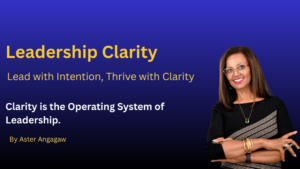 Redefining Leadership: From Control to Clarity
Most organizations do not fail during leadership transitions. They drift.
At year-end, many leadership teams are reviewing results and setting priorities for what comes next. What receives far less attention is what has accumulated quietly underneath those plans.
Leadership changes. Role shifts. Executive churn. Strategy resets are layered on top of one another.
From the outside, this can look like progress. Inside the organization, it often feels like drag.
Not because leaders lack capability. But because clarity erodes faster than most organizations recognize.
What Leadership Churn Actually Breaks
When leadership change outpaces organizational absorption, three patterns consistently emerge.
Decision rights blur. People hesitate. Choices slow. Risk tolerance narrows.
Alignment weakens. Teams remain busy, but priorities multiply, and trade-offs disappear.
Organizational memory fades. The context behind the decisions is fragmented. What was tried, what failed, and why becomes unclear.
None of this appears immediately on dashboards. It shows up later as missed timing, diluted accountability, and fatigue at the top.
Why Hero Leadership Increases Risk in These Moments
Periods of transition often trigger a search for decisive, high-energy leadership. The instinct is understandable.
The risk is structural.
Hero leadership concentrates momentum in individuals at the very moment organizations need shared clarity. During transitions, force can mask confusion rather than resolve it. Execution appears strong until it fractures under scale or stress.
Strong leadership in these moments is quieter. It is deliberate. It reinforces clarity, continuity, and ownership before speed.
This work is rarely visible. It is also rarely optional.
Where This Shows Up Most Often
These patterns surface repeatedly during:
- CEO or chair transitions
- Post-acquisition integration
- Rapid growth phases
- Strategy resets following disruption
- Moments when culture and execution begin to drift apart
These are also the moments when boards feel pressure to move quickly, even as complexity increases.
Speed without clarity rarely delivers the outcome leaders expect.
The Question Worth Asking Before the Year Closes
As planning accelerates, the most important question is not whether the strategy is ambitious enough.
It is this:
Where has leadership change reduced clarity, and who owns restoring it?
Organizations that confront this honestly enter the next year with momentum. Those that do not often spend months rediscovering what they already knew.
This reflection is part of my ongoing work on leadership clarity during transition. Because in moments of change, clarity is not a leadership trait. It is the operating system.
Author’s Note
This reflection draws on patterns I continue to observe across organizations navigating leadership change, growth, and transition. Titles, industries, and strategies differ, but the erosion of clarity follows remarkably similar paths. The intent here is not prescription, but pause. In moments of change, clarity is not a leadership trait. It is the operating system.