


Newsletter
By Aster Angagaw
November 4, 2025
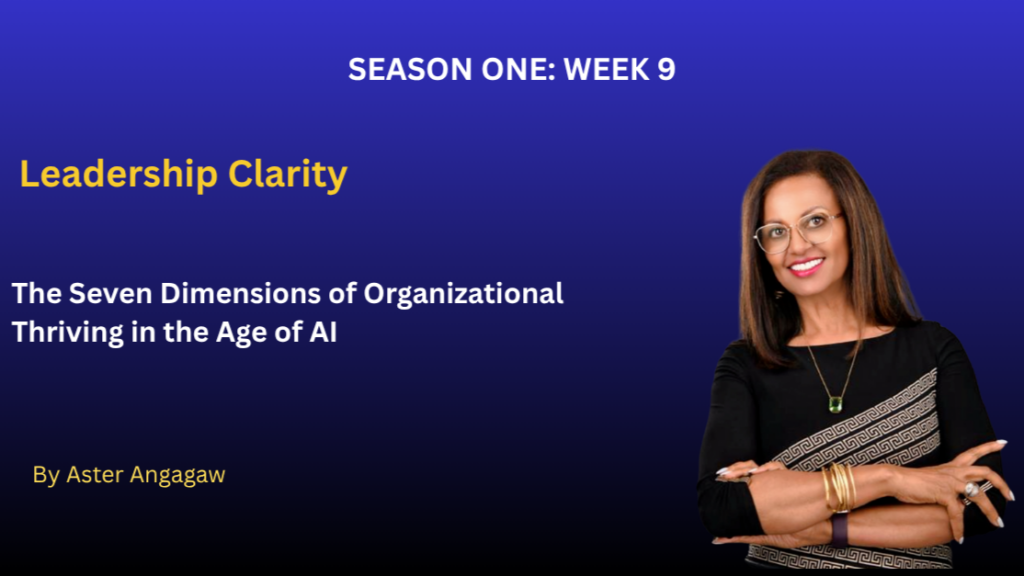 Redefining Leadership: From Control to Clarity
In the industrial age, leadership was measured by control: how much a leader could direct, decide, and dictate. In the digital age, it is measured by clarity: the ability to make sense of complexity, align people around shared purpose, and simplify action in a world where technology changes faster than people can adapt. AI can process complexity. Only humans can simplify it. That is the new leadership advantage.
1) Why Simplicity Is the New Sophistication
Leaders today are drowning in data, dashboards, and decisions. The instinct is to add more: more meetings, more tools, more reports. Yet the most effective leaders subtract. They create clarity by defining what truly matters and removing everything that does not.
“Complexity confuses. Clarity compels.”
Before every major decision, pause and ask three questions:
- What problem are we solving? 2. Why does it matter now? 3. How will we know we are succeeding?
This simple Clarity Check transforms busyness into focus and ensures that technology and teams move in the same direction.
2) AI Demands Clarity of Purpose
AI does not create alignment: it magnifies whatever exists. If your purpose is unclear, AI will multiply confusion. If your purpose is clear, AI becomes a force multiplier for impact. Leaders must define why AI is being used and what human value it should amplify. Without clarity, AI risks becoming another layer of complexity.
3) Clarity in Action – Lessons from Three Leaders
- Amazon – Clarity Through Simplification and Purpose
Two principles guided everything at Amazon: Customer Obsession and Invent and Simplify. Every initiative started with a written narrative clarifying the customer, the problem, and the measurable outcome before a single line of code was written.
“When I led large-scale transformation programs at Amazon, clarity was not a slogan: it was a discipline. That process of defining the why and who created alignment before any technology did. I learned that clarity of purpose is the foundation of every successful innovation, AI-driven or otherwise.”
- EY – Clarity Through Definition and Governance
Before launching hundreds of AI pilots, EY created a firm-wide definition of AI and an internal Client Zero approach to clarify use cases before scaling externally. Frameworks such as the EY.ai Value Accelerator and Responsible AI Framework tie every AI project to measurable business and ethical outcomes. (Source: ey.com)
- Unilever – Clarity Through Human Purpose
Unilever’s AI strategy is anchored in its purpose: to make sustainable living commonplace. Its People Data Centre uses AI ethically to understand consumers while respecting privacy. Each project is evaluated against human-centric principles of transparency, fairness, and impact. (Source: https://www.unilever.com/news/news-search/2024/the-eu-ai-act-has-arrived-how-unilever-is-preparing/)
Together, these organizations show that clarity of purpose, principles, and people is the common denominator of every effective AI implementation.
4) The Seven Dimensions of Clarity
Leadership clarity is not abstract; it is a practice that touches every dimension of thriving:
- Purpose: Anchor every decision in a clear why.
- Work: Simplify priorities; measure outcomes over activity.
- Community: Communicate openly; clarify roles and expectations.
- Self-Care: Model calm and focus; clarity starts with a regulated leader.
- Growth: Make learning pathways simple and visible.
- Money: Connect financial goals to human value creation.
- Play: Keep innovation light and iterative; experimentation with purpose.
- Integration (8th): Bring them together so people see how their work advances purpose.
When clarity is practiced across all dimensions, thriving becomes a design, not an accident.
5) The Clarity Flywheel
Clarity is not a moment; it is a motion. Each cycle reinforces momentum. Clarity → Confidence → Collaboration → Creativity → Performance → Clarity Use it as a quarterly leadership rhythm: – Where do we need more clarity? – What can we simplify? – What should we celebrate and amplify? When teams regularly revisit clarity, momentum becomes sustainable.
6) Closing Reflection
“The greatest gift a leader can offer in times of change is not certainty: it is clarity. Because when people understand the purpose, they can navigate the complexity. And when AI understands the purpose, it can amplify the impact.” Leadership clarity is not about having all the answers. It is about creating the conditions where answers emerge: where technology and human potential move in the same direction.
Author Note
Aster Angagaw is the founder of Astellara and author of We Are So Much More. This article is part of her ten-week series on Organizational Thriving in the Age of AI. AI tools were used to support data and source validation; final content and perspectives reflect the author’s own experience and judgment.
Subscribe to the Leadership Clarity series on LinkedIn to follow the full 10-week journey on Organizational Thriving in the Age of AI.